“Wait, so is this Pilates?”
It’s the question our coaches hear constantly. And it’s understandable! The equipment looks similar, the movements can look controlled and precise, and both use spring-based resistance.
But here’s the truth: Lagree and traditional Pilates are fundamentally different workouts designed for different outcomes. And when you throw HIIT into the comparison, the differences become even more important to understand.
If you’re trying to figure out which workout is right for your body, your goals, and your long-term health, you need to understand what each method actually does, and more importantly, what it doesn’t do.
Let’s break down the science, the philosophy, and the results of each approach so you can make an informed decision about how you train.
What Is Traditional Pilates?
Traditional Pilates was created by Joseph Pilates in the early 1900s as a rehabilitation and conditioning method. It emphasizes controlled movements, proper alignment, core stability, and mind-body connection.
The equipment—most commonly the reformer—uses springs, pulleys, and a sliding carriage to create adjustable resistance. Exercises are typically performed from lying or seated positions with a focus on precision, breath work, and smooth, flowing movements.
What Pilates Does Well:
Traditional Pilates excels at building core strength, improving flexibility, enhancing body awareness, and rehabilitating injuries. It’s gentle on joints and accessible to nearly all fitness levels and ages.
The controlled pace allows you to focus on proper form and alignment. The emphasis on breath and mindfulness creates a meditative quality that many people find therapeutic.
For people recovering from injury, dealing with chronic pain, or looking to improve posture and mobility, traditional Pilates is incredibly effective.
What Pilates Doesn’t Do:
Traditional Pilates is low-intensity by design. Your heart rate stays relatively low, and you don’t reach the metabolic demand needed for significant fat burning or cardiovascular conditioning.
While it builds muscular endurance, it doesn’t create the time-under-tension or resistance needed for substantial strength gains or muscle building.
If your goals include significant fat loss, building lean muscle mass, or improving cardiovascular fitness, traditional Pilates alone won’t get you there. It’s a piece of the puzzle, not the complete picture.
What Is Lagree (Megaformer Training)?
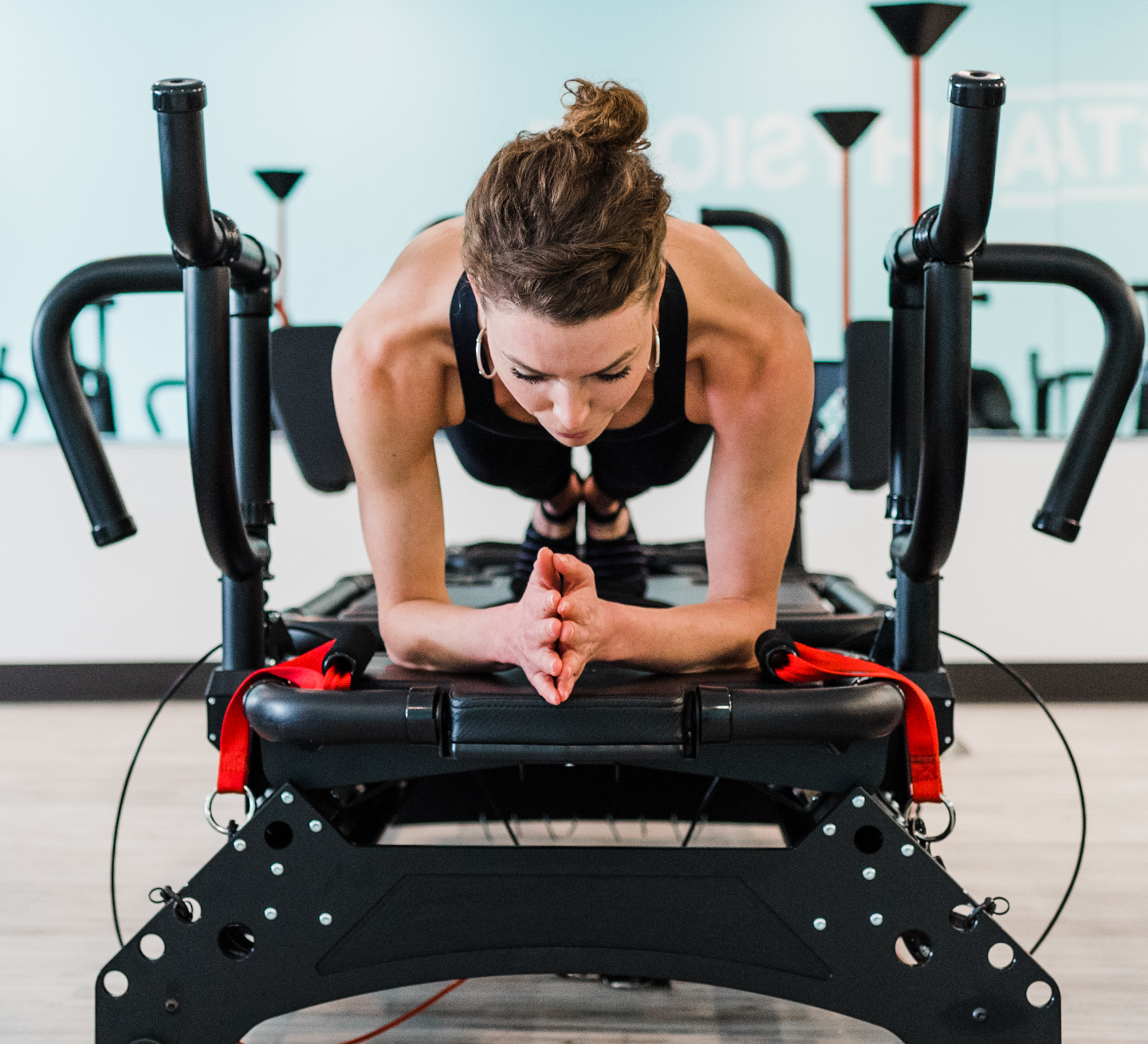
Lagree is a workout method created by fitness innovator Sebastien Lagree in the early 2000s. While it uses reformer-style equipment (called a Megaformer), the philosophy and execution are completely different from Pilates.
Lagree is designed around one core principle: effective intensity. The goal is to create maximum muscle stimulation and cardiovascular demand in minimum time—all while keeping impact on joints near zero.
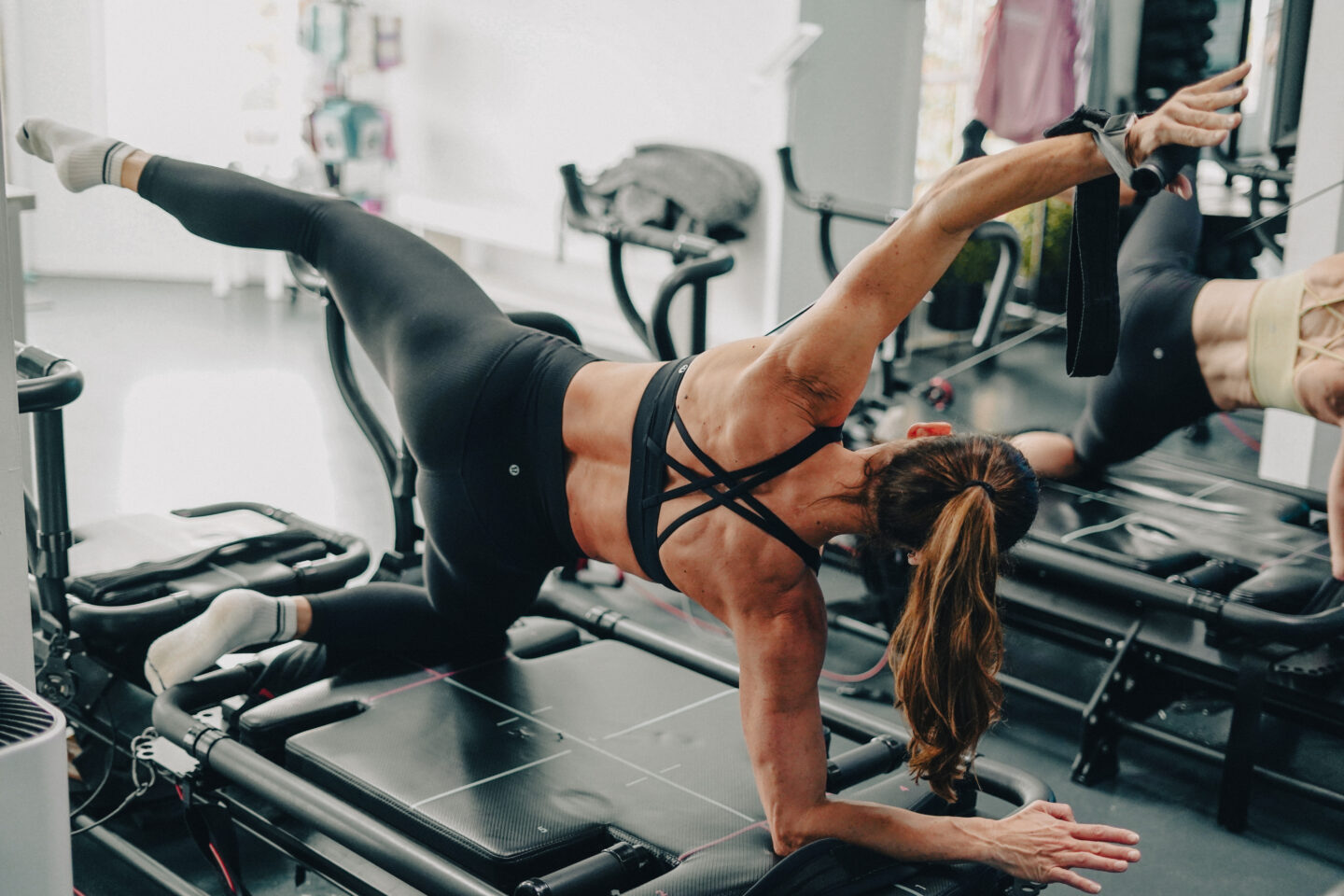
The Megaformer uses spring-based resistance, but exercises are performed slowly and under constant tension, often incorporating instability to force deep muscle engagement. Movements frequently include standing work, planks, lunges, and compound exercises that challenge multiple muscle groups simultaneously.
The Science of Time Under Tension:
The defining characteristic of Lagree is slow, controlled movement with no rest between exercises. Muscles remain under continuous tension for the entire 40 minute class.
This time-under-tension protocol forces muscles to work in their weakest range of motion, recruits slow-twitch and fast-twitch muscle fibers, and creates metabolic stress that triggers muscle adaptation and growth.
The result? Your muscles shake, fatigue sets in, and you experience “failure” repeatedly throughout class—the point where muscles can no longer maintain proper form. This is the stimulus that creates change.
Research shows that time-under-tension training is highly effective for building muscular strength and endurance, increasing lean muscle mass, and elevating metabolic rate both during and after exercise.
What Lagree Does Well:
Lagree combines strength training, muscular endurance, core stability, cardiovascular conditioning, and flexibility into one efficient workout.
Because movements are slow and controlled, there’s virtually no impact on joints, spine, or connective tissue. This makes it safe for people with joint issues, past injuries, or anyone who can’t handle high-impact exercise.
Yet despite being low-impact, Lagree is genuinely high-intensity. Heart rates stay elevated throughout class, often reaching 75-85% of maximum. You burn significant calories during the workout and continue burning them for hours afterward due to excess post-exercise oxygen consumption (EPOC).
The muscle shaking you experience isn’t just for show, it’s a sign that you’re recruiting deep stabilizer muscles and working muscles to fatigue, which is necessary for gaining strength and body composition changes.
Lagree builds long, lean muscle without bulk. It improves functional strength that translates to everyday movement. And it does all this in 40 minutes, making it time-efficient for people with busy lives.
What Sets InstaPhysique’s Approach Apart:
While traditional Lagree studios focus purely on slow, controlled movements, InstaPhysique takes an athletic approach that incorporates explosive intervals, heavy load training, and sport-specific timing patterns into the Megaformer work.
This means you’re not just building endurance – you’re developing power, speed, and maximal strength alongside it. The programming includes hypertrophy-focused protocols for muscle building, explosive movements for athletic performance, and varied tempo training that challenges your body in multiple ways.
For competitive athletes or anyone looking for sport-specific conditioning, InstaPhysique’s approach bridges the gap between traditional Lagree and performance training. You get the joint-protective benefits of low-impact work combined with the athletic demands that drive real power and strength gains.
The workout is demanding, and intentionally so. The constant muscle fatigue and shaking signal that you’re working at true intensity, which is exactly where adaptation happens. For beginners, modifications and coaching ensure you can scale appropriately while still being challenged.
What Is HIIT (High-Intensity Interval Training)?
HIIT involves short bursts of maximum-effort exercise followed by brief recovery periods. Think sprinting, jumping, burpees, battle ropes, or any explosive movement done at near-maximal intensity.
The goal is to push your cardiovascular system and metabolism to their limits in short time frames, typically 20-30 minutes total.
What HIIT Does Well:
HIIT is incredibly effective for burning calories, improving cardiovascular fitness, and triggering fat loss. The intensity creates a significant afterburn effect, meaning you continue burning calories at an elevated rate for hours post-workout.
It’s time-efficient—you can get a complete workout in 20-30 minutes. And it’s adaptable to almost any format: running, cycling, bodyweight exercises, or equipment-based work.
HIIT improves VO2 max (aerobic capacity) more efficiently than steady-state cardio. For athletes or anyone looking to improve cardiovascular performance, HIIT delivers results.
What HIIT Doesn’t Do (And Why It Can Be Problematic):
Here’s where HIIT becomes complicated—and where many people run into trouble.
HIIT is high-impact by nature. Jumping, sprinting, and explosive movements create repetitive stress on joints, particularly knees, hips, ankles, and the spine. Over time, this increases injury risk, especially if you have pre-existing joint issues or poor movement patterns.
The intensity that makes HIIT effective also makes it difficult to sustain long-term. Your central nervous system can only handle so much high-intensity work before you experience burnout, overtraining, or decreased performance.
Most people can’t do true HIIT more than 2-3 times per week without running into recovery issues. Yet many boutique fitness studios program HIIT-style classes 5-6 days a week, which is a recipe for injury or exhaustion.
HIIT also doesn’t build significant muscle mass or strength. While it burns calories, it doesn’t create the time-under-tension needed for muscle growth. Many people who rely solely on HIIT end up with a “skinny fat” physique—low muscle mass despite being lean.
And perhaps most importantly: HIIT doesn’t build bodies that last. The repetitive impact and constant stress work against longevity, joint health, and functional movement quality as you age.
The Critical Difference: Prehab vs. Rehab
This is where philosophy matters as much as methodology.
Traditional Pilates was created as rehabilitation; helping people recover from injury or surgery, restore movement quality, and build foundational strength.
HIIT is designed for performance; pushing your body to its limits to maximize calorie burn and cardiovascular fitness in minimal time.
Lagree was designed as prehabilitation; building bodies that are strong, resilient, and resistant to injury in the first place, so you never need rehabilitation.
The Prehab Philosophy:
Prehabilitation means training your body to handle the demands of life and sport without breaking down. It means building strength in stabilizer muscles, improving movement quality, creating balanced musculature, and avoiding the repetitive stress that leads to overuse injuries.
It’s the difference between training your body into the ground and training your body for the long haul.
At InstaPhysique, this prehab approach is central to everything. The goal isn’t just to make you sweat or exhaust you—it’s to build a body that functions optimally, moves well, stays injury-free, and feels strong year after year.
Low-impact doesn’t mean easy. It means smart. It means sustainable. It means you can train intensely without destroying your joints in the process.
Comparing the Three: Which Does What?
Let’s break down how Lagree, Pilates, and HIIT compare across key fitness outcomes:
Strength Building
- Traditional Pilates: Builds moderate strength, particularly core and stabilizers. Limited resistance means limited strength gains beyond beginner level.
- Lagree: Builds significant strength through time-under-tension and variable resistance. Effective for developing lean muscle and functional strength.
- HIIT: Minimal strength gains. Primarily cardiovascular with some muscular endurance, but not enough resistance or time-under-tension for real strength development.
Muscle Toning and Body Composition
- Traditional Pilates: Creates long, lean muscles and improves muscle tone moderately. Not ideal for significant body recomposition.
- Lagree: Highly effective for body recomposition, building lean muscle while burning fat. Creates the toned, sculpted look most people want.
- HIIT: Burns fat effectively but doesn’t build muscle. Can lead to muscle loss if not paired with resistance training.
Cardiovascular Fitness
- Traditional Pilates: Minimal cardiovascular benefit. Heart rate stays relatively low.
- Lagree: Moderate to high cardiovascular demand. Heart rate remains elevated throughout, improving cardiovascular endurance.
- HIIT: Maximum cardiovascular benefit. Most effective for improving aerobic capacity.
Joint Health and Injury Risk
- Traditional Pilates: Very low injury risk. Excellent for joint health and rehabilitation.
- Lagree: Very low injury risk. Gentle on joints while still providing high intensity. Supports joint stability through strength.
- HIIT: High injury risk, especially with poor form or overtraining. Repetitive impact stresses joints over time.
Flexibility and Mobility
- Traditional Pilates: Excellent for flexibility and mobility. Emphasizes stretching and range of motion.
- Lagree: Excellent for flexibility and mobility. Movements incorporate full range of motion and active stretching.
- HIIT: Minimal flexibility benefits. Often involves limited range of motion in explosive movements.
Core Strength
- Traditional Pilates: Excellent core development. Core engagement is central to every exercise.
- Lagree: Excellent core development. Core remains engaged throughout every movement, often under instability.
- HIIT: Moderate core engagement depending on exercise selection. Not a primary focus.
Time Efficiency
- Traditional Pilates: 50-60 minute classes typical. Moderate intensity means longer workout needed for calorie burn.
- Lagree: 40 minute classes deliver complete workout. High efficiency due to continuous work and no rest.
- HIIT: 30-60 minute sessions. Time-efficient for cardiovascular work and calorie burn.
Sustainability Long-Term
- Traditional Pilates: Highly sustainable. Can be practiced for life at any age.
- Lagree: Highly sustainable. Low-impact nature allows for frequent training without breakdown.
- HIIT: Difficult to sustain long-term. High injury risk and CNS fatigue limit frequency and longevity.
Longevity and Aging Well
- Traditional Pilates: Good for longevity. Maintains mobility, balance, and functional movement as you age.
- Lagree: Excellent for longevity. Builds strength and resilience while protecting joints—key factors in healthy aging.
- HIIT: Poor for longevity. Joint stress and injury risk increase as you age. Not sustainable for older populations.
The Low-Impact, High-Intensity Paradox Explained
Here’s what confuses people: How can something be low-impact but still high-intensity? Aren’t those opposites?
Not at all. Impact and intensity are two completely different variables.
Impact refers to the force placed on your joints, bones, and connective tissues. Running, jumping, and plyometrics are high-impact because each foot strike or landing creates stress equivalent to 2-4 times your body weight.
Intensity refers to the metabolic and muscular demand of the work. How hard your muscles are working, how elevated your heart rate is, and how much effort you’re expending.
Lagree proves you can have maximum intensity with minimal impact. By using slow, controlled movements with constant tension, muscles work at their maximum capacity without any of the joint stress that comes from explosive or repetitive impact.
Your muscles shake because they’re working harder than they would during impact-based exercise. Your heart rate stays elevated because your body is under continuous metabolic demand. Yet your joints are safe because there’s no pounding, no explosive force, no repetitive stress.
This is the holy grail of training: getting maximum results with minimum risk.
Who Should Do Which Workout?
The right choice depends entirely on your goals, your body, and where you are in your fitness journey.
Choose Traditional Pilates If:
- You’re recovering from injury or surgery
- You have chronic pain or significant mobility limitations
- You prioritize flexibility and mindful movement over intensity
- You want a meditative, low-stress workout experience
Choose Lagree If:
- You want to build lean muscle and improve body composition
- You need a time-efficient, results-driven workout
- You want high intensity without joint stress
- You’re looking for functional strength that translates to real life
- You want to train frequently without breaking down your body
- You care about longevity and building a body that lasts
- You’ve plateaued with traditional Pilates and need more challenge
Choose HIIT If:
- You’re training for a specific sport or event requiring cardiovascular endurance
- You have no joint issues and excellent movement quality
- You want maximum calorie burn in minimum time
- You’re pairing it with resistance training (not doing it exclusively)
- You’re limiting HIIT sessions to 2-3 times per week max
- You’re young and injury-free (and want to stay that way, so be careful)
What Makes InstaPhysique Different: The Complete Approach
Most studios specialize in one modality. They’re either a Pilates studio or a HIIT studio or a yoga studio. You get what they offer—and nothing more.
InstaPhysique takes a different approach, one built on the understanding that optimal fitness requires multiple elements working together.
Lagree Megaformer Training: High-intensity, low-impact strength and conditioning that builds lean muscle, burns fat, and protects joints. This is the foundation—the workout that delivers results without breaking you down.
Rebounder Classes: Low-impact cardio on mini trampolines that boosts cardiovascular health, lymphatic drainage, and metabolic function while keeping joint stress near zero.
CAROL Bike: AI Bike that pushes to your max in under 10 minutes, improving VO2 Max by up to 12% in just 8 weeks.
Recovery Services: Infrared sauna and lymphatic roll massage that reduce inflammation, accelerate recovery, improve circulation, and support overall wellness. Because recovery isn’t optional, it’s where adaptation happens.
Metabolic Testing: Clinical-grade PNOĒ testing that reveals your VO2 max, metabolic rate, fat-burning zones, and biological age. Because guessing at your training and nutrition is inefficient.
This isn’t just a gym where you take a class and leave. It’s a complete ecosystem designed to build bodies that are strong, functional, resilient, and built for longevity.
The philosophy is simple: train smart, recover properly, measure progress, and do it all in a way that your body can sustain for decades.
The Question Isn’t Just “What Workout Is Best?” It’s “What Can You Do For Life?”
Here’s the reality most fitness marketing ignores: the best workout isn’t the one that destroys you today. It’s the one that builds you up progressively, keeps you injury-free, and you can still do 20 years from now.
HIIT might burn more calories in 20 minutes, but can you do it 3-4 times a week for years without injury? Most people can’t.
Traditional Pilates might be gentle and therapeutic, but does it challenge your body enough to drive real adaptation and change? For many goals, it doesn’t.
Lagree sits in the sweet spot: intense enough to drive results, smart enough to protect your body, efficient enough to fit into a busy life, and sustainable enough to become a long-term practice.
It’s not about what’s trendy. It’s about what works. Not just this month, but this decade and beyond.
Beyond the Workout: The Longevity Equation
As the fitness industry matures, we’re seeing a critical shift. The conversation is moving away from “how can I lose 10 pounds before vacation” and toward “how can I build a body that functions optimally for as long as possible?”
This is longevity thinking—and it changes everything.
Longevity isn’t about obsessing over one metric. It’s about building physical capacity across multiple domains: strength, cardiovascular fitness, mobility, metabolic health, and resilience.
It’s about avoiding injury and overuse patterns that accumulate into chronic problems. It’s about maintaining muscle mass as you age, because sarcopenia (age-related muscle loss) is one of the strongest predictors of mortality and loss of independence.
It’s about keeping your joints healthy so you can stay active. It’s about training your cardiovascular system so your heart and lungs remain strong. It’s about metabolic health so you avoid chronic disease.
Lagree-based training checks all these boxes. It builds the muscle you need to maintain as you age. It strengthens your cardiovascular system. It protects your joints while still providing intensity. It improves metabolic function.
Paired with proper recovery and personalized data from metabolic testing, it becomes a complete longevity strategy—not just a workout.
The Sacramento and Roseville Advantage: Where Science Meets Community
Finding a studio that combines intelligent programming, advanced recovery, metabolic testing, and genuine community isn’t easy. Most places offer one piece of the puzzle.
InstaPhysique brings it all together in Sacramento and Roseville with three locations designed to make world-class training and wellness accessible.
It’s locally owned and operated—not a franchise churning out identical experiences. The instructors know your name, understand your goals, and provide personalized attention in every class.
Classes are capped at 12-16 people, so you’re never lost in a crowd. You get hands-on coaching, form corrections, and modifications tailored to your body.
The atmosphere isn’t about intimidation or comparison. It’s about showing up, working hard, supporting each other, and leaving stronger than you arrived.
And because it’s a complete wellness hub—Megaformer training, rebounder cardio, infrared sauna, lymphatic massage, and metabolic testing—you’re not bouncing between multiple studios and services. Everything you need is in one place.
This is what modern fitness should look like: intelligent, sustainable, personalized, and community-driven..
Ready to experience the difference? InstaPhysique in Sacramento and Roseville offers Lagree Megaformer training, CAROL Bike, rebounder classes, infrared sauna, lymphatic roll massage, and clinical-grade metabolic testing—all designed to help you build the strongest, healthiest version of yourself.
New to InstaPhysique? Start with the intro offer: 8 classes in 2 weeks for $79, plus a free wellness session so you can experience the complete approach to fitness and recovery.
Your body will thank you, today and decades from now.