Can You Really Build Muscle Without High-Impact Exercise?
If you’ve been told that building muscle requires heavy weights, explosive movements, or high-impact exercises that leave your joints aching, it’s time to learn about a different approach. Low-impact workouts can be just as effective—and in some cases, more effective—at building lean muscle mass when they leverage the science of time under tension.
The key isn’t about how much weight you lift or how hard you land. It’s about how long your muscles work and the type of contraction they experience during that work.
What Makes a Workout “Low-Impact”?
Low-impact exercise means your feet stay in contact with the ground, or your body is supported in a way that minimizes stress on your joints. Unlike running, jumping, or plyometric movements that create force equal to multiple times your body weight with each landing, low-impact workouts eliminate the repetitive pounding that leads to cartilage breakdown, stress fractures, and inflammatory joint conditions. Instead of relying on gravity and impact to create intensity, low-impact training uses resistance, positioning, and sustained muscle tension to challenge your body. This means you can push your muscles to complete fatigue and achieve a cardiovascular challenge without subjecting your spine, hips, knees, and ankles to the cumulative trauma that sidelines so many athletes and fitness enthusiasts.
This makes low-impact training ideal for:
- Anyone who wants results without risking injury or chronic joint damage
- People recovering from injuries or managing existing joint pain
- Young professionals building sustainable fitness habits that won’t break down their bodies
- Postpartum women rebuilding core and pelvic floor strength safely
- Active individuals over 35 who refuse to choose between results and longevity
- Athletes seeking intense training that supports rather than compromises performance
- Beginners intimidated by high-impact gym culture who still want serious results
- Anyone who’s experienced the consequences of high-impact training and wants a smarter approach
The Science: How Muscles Actually Grow
Muscle growth, or hypertrophy, happens when you create enough mechanical tension and metabolic stress to trigger your body’s adaptive response. For decades, we’ve been taught this requires lifting progressively heavier weights. But research shows that time under tension—keeping muscles working continuously without rest—can produce the same muscle-building stimulus.
Here’s what happens at the cellular level during time under tension training:
Mechanical Tension: When you hold a position or move slowly through a range of motion, your muscle fibers must sustain contraction for extended periods. This prolonged tension signals your body that the muscle needs to grow stronger and larger to handle the demand.
Metabolic Stress: Continuous muscle engagement without rest depletes oxygen and creates metabolic byproducts like lactate. This metabolic environment triggers hormone release and cellular swelling that contributes to muscle growth—without requiring heavy external loads.
Muscle Fiber Recruitment: Slow, controlled movements with sustained tension recruit both slow-twitch and fast-twitch muscle fibers. As your slow-twitch fibers fatigue during extended holds, your body recruits fast-twitch fibers to maintain the contraction, creating comprehensive muscle development.
Time Under Tension vs. Traditional Strength Training
Traditional strength training typically focuses on lifting heavy weights for 8-12 repetitions with rest periods between sets. Each rep might take 2-3 seconds, meaning your muscles work for about 24-36 seconds per set before resting.
Time under tension training flips this approach. Instead of brief bursts of maximum effort followed by rest, you might hold a single position or perform ultra-slow movements for 60-90 seconds continuously. Your muscles never fully relax, forcing them to work in a fatigued state that maximizes both mechanical tension and metabolic stress.
The result? You can achieve similar or superior muscle-building results with minimal joint impact and significantly reduced injury risk.
Why Slow Movements Build More Muscle Than You Think
Speed masks weakness. When you perform fast repetitions, momentum does much of the work. Your muscles only engage fully at the beginning and end of each movement, with the middle portion coasting on inertia.
Slow, controlled movements eliminate momentum entirely. Every millisecond of the exercise requires active muscle engagement. This constant tension means:
- Greater total muscle fiber activation throughout the entire range of motion
- Enhanced mind-muscle connection and movement awareness
- Improved eccentric strength (the lowering phase, which is crucial for muscle growth)
- Reduced cheating or compensation patterns that can lead to injury
Research published in the Journal of Physiology shows that slow-tempo resistance training produces comparable muscle growth to traditional heavy lifting, with the added benefit of improved muscle endurance and control.
The Megaformer Advantage: Engineering Meets Exercise Science
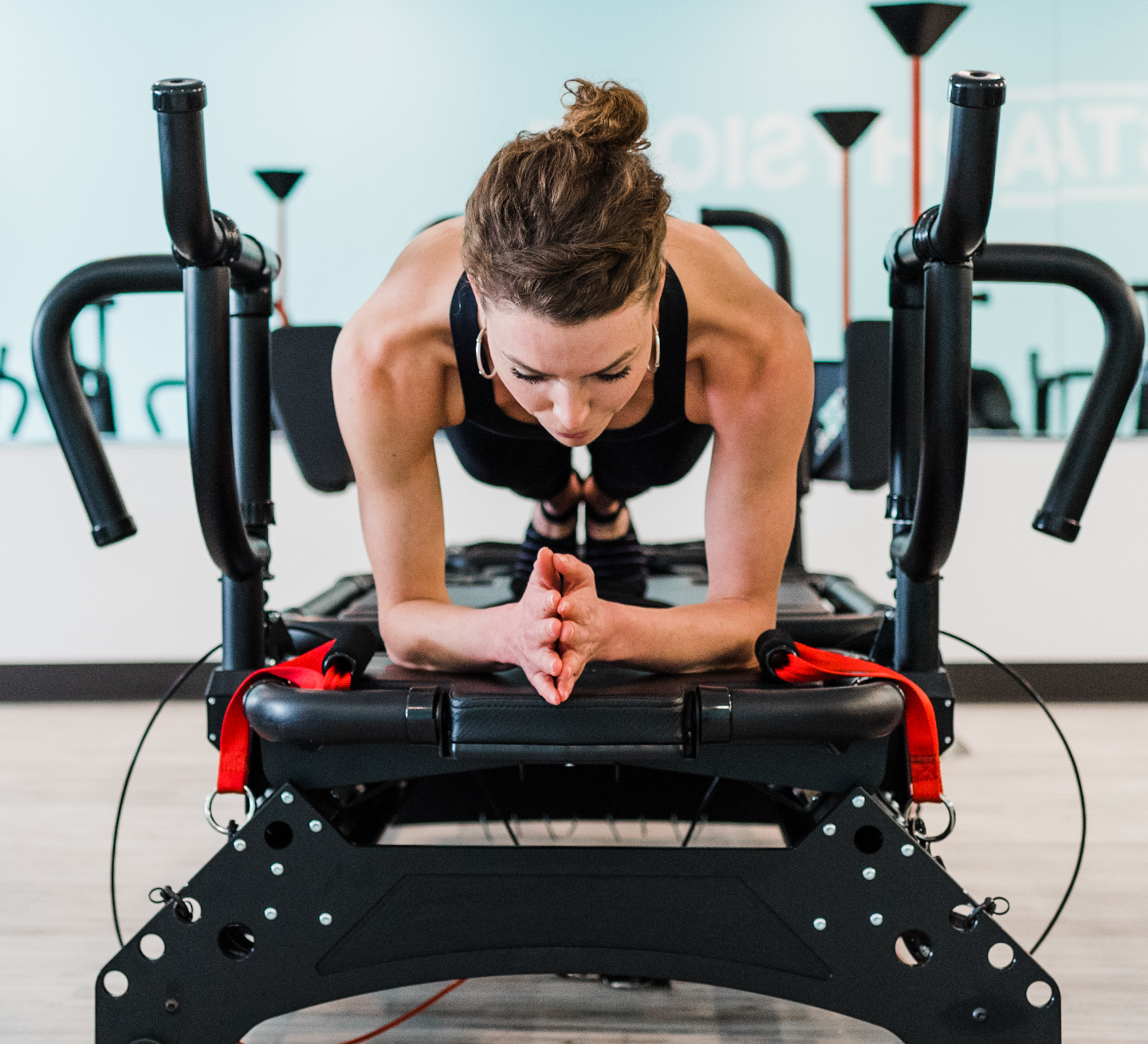
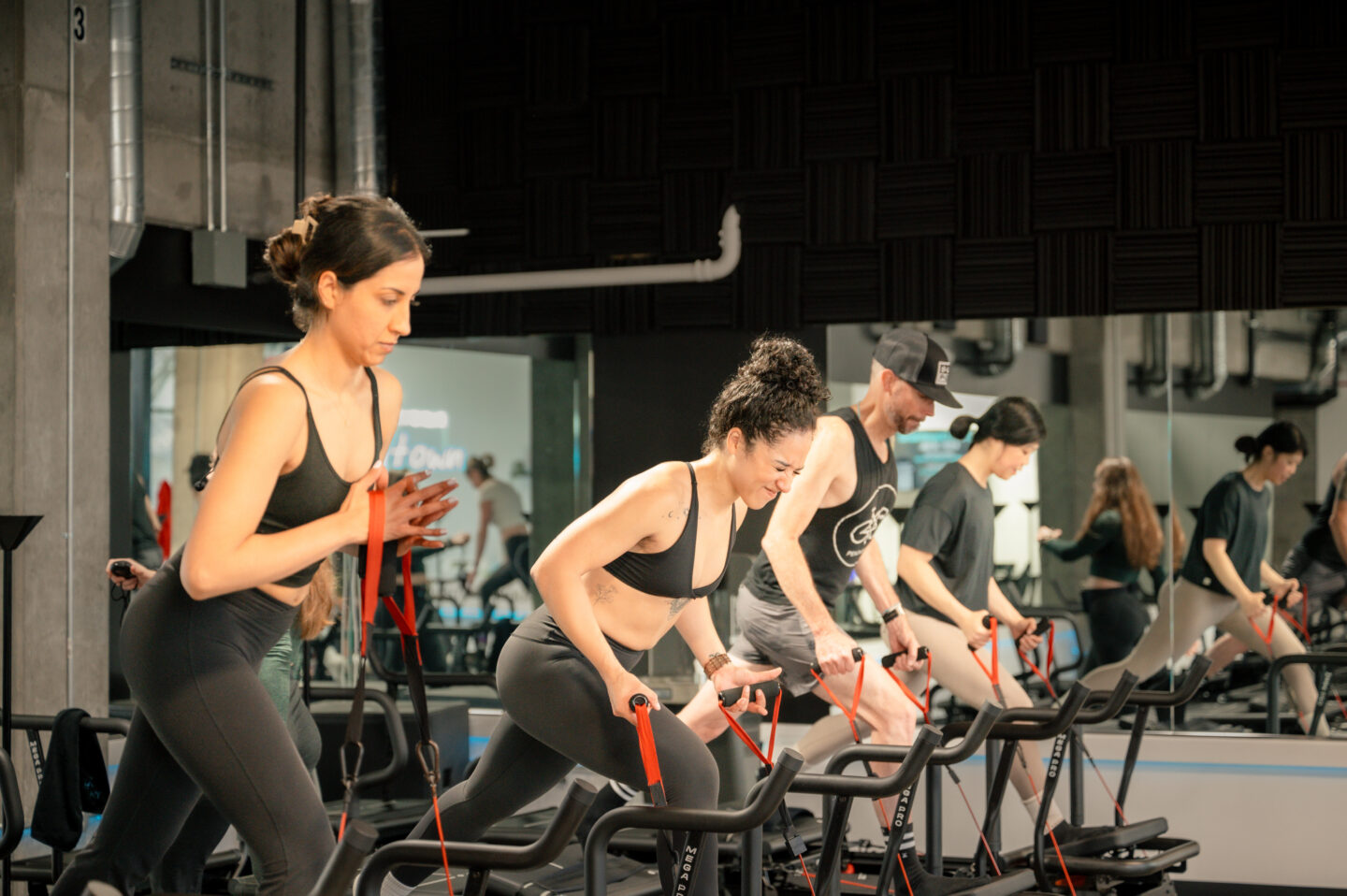
The Lagree Method, performed on the Megaformer machine, was specifically designed to maximize time under tension while maintaining zero impact on joints. Unlike reformer Pilates or traditional strength equipment, the Megaformer uses spring resistance that remains constant throughout every movement, meaning your muscles never get a break.
The machine’s design creates several unique advantages:
Variable Spring Resistance: Unlike gravity-based weights that only provide resistance in one direction, springs create constant tension during both the pushing and pulling phases of movement. Your muscles work just as hard lowering as they do lifting.
Unstable Carriage System: The moving platform requires constant core engagement and stabilizer muscle activation. You’re not just working your prime movers; every exercise becomes a full-body integration challenge.
Infinite Range Possibilities: The cable and pulley system allows movements in multiple planes that would be impossible with traditional weights, creating functional strength that translates to real-world movement patterns.
What to Expect: The Physical Experience of Time Under Tension
If you’re used to traditional workouts, time under tension training feels completely different. Within 30-40 seconds of sustained work, you’ll experience:
The Shake: Your muscles will begin to tremble as individual muscle fibers fatigue and your nervous system recruits fresh fibers to maintain the contraction. This shaking is not a sign of weakness—it’s evidence that you’re working at the precise intensity needed for muscle adaptation.
The Burn: As metabolic byproducts accumulate in working muscles, you’ll feel an intense burning sensation. This discomfort is temporary and indicates you’re creating the metabolic stress that contributes to muscle growth.
Cardiovascular Challenge: Even though you’re not jumping or running, your heart rate will climb. Sustained muscle contractions compress blood vessels, making your cardiovascular system work harder to deliver oxygen to working muscles.
Mental Intensity: Time under tension training is as much mental as physical. When every second feels challenging, staying present and maintaining form requires significant mental fortitude.
Real Results: What Science and Experience Show
Studies comparing time under tension training to traditional strength training show:
- Similar muscle mass gains when volume and intensity are equated
- Superior muscle endurance improvements
- Greater improvements in muscle control and movement quality
- Significantly lower injury rates
- Better adherence rates (people stick with it longer)
At InstaPhysique, our clients consistently report visible muscle definition within weeks, improved posture and core strength, and enhanced athletic performance in their primary sports or activities.
Who Benefits Most from Low-Impact, High-Intensity Training?
While anyone can benefit from time under tension training, certain populations find it particularly transformative:
Postpartum Women: The combination of core integration, pelvic floor awareness, and zero-impact loading makes this approach ideal for rebuilding strength after pregnancy without risking pelvic floor dysfunction or diastasis recti complications.
Former or Current Runners and CrossFitters: Athletes dealing with overuse injuries or wanting to maintain fitness while recovering find they can work at high intensity without aggravating existing issues.
Those Focused on Longevity: People who want to look and feel strong but can’t afford injury downtime appreciate the efficiency and joint-protective nature of this training style.
Anyone with Joint Pain: Arthritis, past injuries, or joint sensitivity don’t have to mean accepting muscle loss. Low-impact time under tension training builds strength while protecting vulnerable joints.
How to Maximize Results from Time Under Tension Training
To get the most from this training approach:
Prioritize Form Over Speed: The slower and more controlled your movements, the greater the tension and the better your results. If you find yourself speeding up, you’re likely using momentum instead of muscle.
Embrace the Shake: When your muscles start trembling, you’re in the zone. Push through for another 10-20 seconds for maximum benefit.
Focus on Breath: Holding your breath increases blood pressure and reduces oxygen delivery to working muscles. Steady breathing helps you sustain effort longer.
Consistency Matters: Muscles adapt to sustained tension training differently than traditional lifting. Plan for 3-4 sessions per week with at least one rest day between sessions.
Progressive Overload: As exercises become easier, increase difficulty by adding spring resistance, slowing tempo further, or increasing range of motion—not by speeding up.
The Bottom Line: Impact Doesn’t Equal Results
The fitness industry has long equated intensity with impact, leading many people to believe they must choose between effective workouts and healthy joints. The science of time under tension proves this is a false choice.
When you understand how muscles actually grow and apply that knowledge through properly designed low-impact training, you can build significant strength and muscle definition while protecting your body for the long term.
At InstaPhysique, we’ve seen countless clients transform their bodies and their relationship with exercise by discovering that they can work harder than they ever thought possible—without a single jump, heavy weight, or joint-damaging movement in sight.
Frequently Asked Questions
How long does it take to see muscle definition from low-impact training? Most people notice increased muscle tone and definition within 3-8 weeks of consistent training (3-4 sessions per week). Strength improvements are often noticeable within 2-3 weeks.
Is time under tension training suitable for beginners? Yes. The principle scales beautifully—beginners start with lighter resistance and shorter duration holds, progressively increasing both as they build strength and endurance.
Can you build as much muscle with low-impact training as with heavy weights? Research shows that when volume and intensity are equated, time under tension training produces comparable muscle growth to traditional heavy lifting, with the added benefits of improved muscle endurance and reduced injury risk.
How is this different from Pilates? While both are low-impact, Lagree Method training on the Megaformer maintains constant spring tension throughout movements and emphasizes muscular failure within 60-90 seconds, creating greater metabolic stress and mechanical tension than traditional Pilates.
Will this help me lose weight? Time under tension training builds lean muscle mass, which increases your resting metabolic rate. Combined with proper nutrition, this training style supports fat loss while preserving or building muscle—creating the “toned” look most people seek.
Ready to experience the science of time under tension training for yourself? InstaPhysique offers Lagree Method classes on the Megaformer, combining all the principles discussed here with expert coaching and a supportive community in Sacramento & Roseville. Your joints will thank you.
Book a Megaformer Class in Sacramento or Roseville