The 90-Day Window: What Happens After Your First Class
The strength you feel in your first few weeks of Megaformer training doesn’t come from new muscle. It comes from your nervous system.
This is one of the most useful things to understand about any resistance-based training program — and it’s especially true on the Megaformer. In the first three to four weeks, your brain is learning to recruit motor units more efficiently. You become better at using the muscle you already have. The sensation of getting stronger is real. The mechanism isn’t what most people expect.
That distinction matters because it reframes what 90 days of consistent practice actually produces, and why that window is where the real change happens.
Weeks 1-4: Your nervous system is doing the heavy lifting
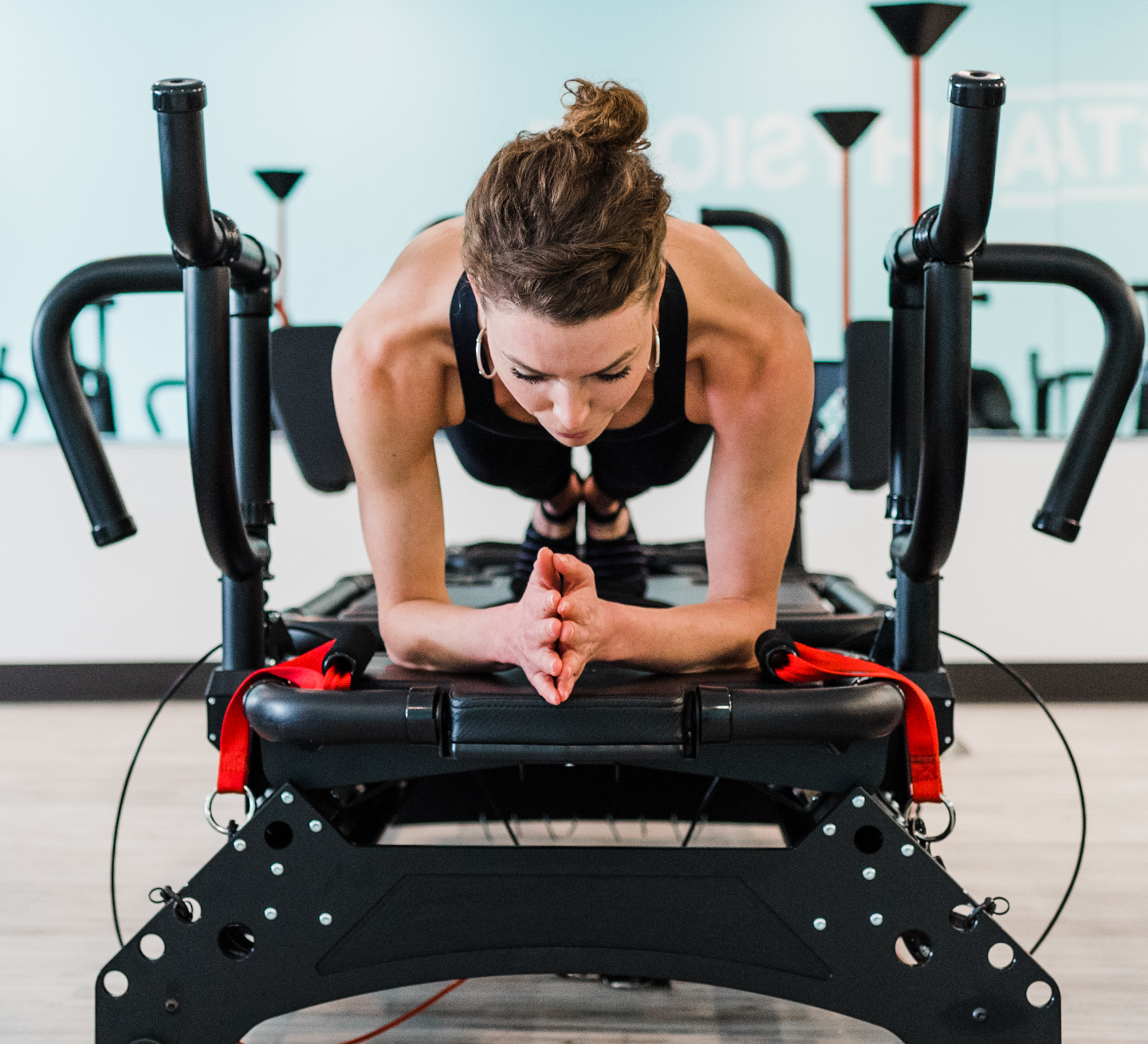
The Megaformer introduces something most training formats don’t require: continuous stabilization on a moving surface. The carriage shifts beneath you throughout every movement. Your body can’t brace against something fixed — it has to actively manage load across multiple axes simultaneously.
That demand activates stabilizer muscles, particularly in the hips, deep core, and shoulder girdle that rarely get targeted in conventional strength or cardio training. In the first few weeks, your nervous system is learning to coordinate these patterns.
This is also why most people notice improvements outside the studio before they see anything in the mirror. Better posture at a desk. Less fatigue climbing stairs. More ease carrying groceries. The nervous system is adapting faster than the body’s visible architecture.
Weeks 4-8: Structural change begins
Around the four- to six-week mark, the training stimulus starts producing structural changes in muscle tissue itself. Myofibrils — the protein filaments inside muscle fibers — increase in density. This is actual hypertrophy, distinct from the neural adaptation of the early weeks.
Because Megaformer work emphasizes slow, controlled movement — typically 10-15 seconds per phase of each repetition — time under tension is significantly higher than in a conventional workout of the same duration. That sustained muscular demand is particularly effective at developing slow-twitch (Type I) muscle fibers. These are the fibers built for endurance, postural support, and metabolic efficiency. They’re also the fibers that become more important as we age.
Connective tissue, tendons and ligaments, adapt more slowly than muscle – typically two to four weeks behind. If the first six weeks feel harder than you’d expect given your fitness history, this lag is part of the explanation. The low-impact format of the Megaformer matters here: high intensity without high joint load gives connective tissue time to adapt rather than accumulate wear.
Weeks 8-12: The metabolic shift
By the third month, something has changed at the metabolic level. Mitochondrial density — the number of energy-producing structures inside your muscle cells — has increased. Your body processes fuel more efficiently, both at rest and during effort. Resting metabolic rate may increase modestly as functional muscle tissue develops.
More practically: the things that felt effortful start to feel like baseline. Members who come twice a week often describe something changing in how they organize their schedule — sessions start to feel non-negotiable rather than earned. This isn’t motivation in the pop-psychology sense. It’s a physiological adaptation. The body has registered the training stimulus as expected — and has started to plan for it.
This is also when the risk of stopping becomes concrete. Detraining — the reversal of neural and structural adaptation — begins within two weeks of cessation. The neural gains are first to go.
What “consistent” actually means
Two sessions per week is the functional floor for the adaptations described above. Research on resistance-based training consistently shows that twice-weekly stimulation is sufficient to drive both neuromuscular and structural change for most people.
Three sessions per week accelerates connective tissue remodeling and extends the stimulus across more days, which compounds both structural development and metabolic adaptation.
One session per week maintains a baseline but is unlikely to produce progressive adaptation across a 90-day window.
For most people, two to three sessions per week — classes, recovery work, or some combination keeps you inside the adaptation window. That’s the practical version of consistent.
The question worth asking at 90 days
Not “how do I look” — though that tends to follow.
The better question is: what did you come in wanting to feel different, and do you feel it yet?
That’s a more useful measure than the mirror, and it’s worth talking through with someone who knows your history in the studio. If you’re approaching 90 days — or just starting your first two weeks — a Goal Review at any InstaPhysique location is 15 minutes well spent. No commitment. Just a conversation about where you are and what’s next.
Ready to book? We have classes in Sacramento (Midtown & Arden), Roseville, and Folsom (coming soon!)
FAQ
How often should you do Lagree to see results?
Take two to three Megaformer classes a week. One class a week maintains your fitness, but two to three keeps you in the adaptation window, where the body rebuilds stronger between sessions — typically producing visible results within 90 days. Because Lagree is low-impact, you can sustain that frequency without overtraining.
How long does it take to see results from the Megaformer?
Most people feel results — energy, sleep, strength — within the first two weeks, notice changes by weeks three to six, and see visible body-composition changes around weeks six to twelve. This 8-to-12-week arc is why InstaPhysique uses the 90-day mark as a natural checkpoint.
Is one InstaPhysique class a week enough?
One class a week is enough to maintain a baseline but generally not enough to drive progressive change, because the benefit fades before the next class. Two to three classes a week is the practical minimum for visible results.
Where can I take Megaformer classes in Sacramento, Roseville, and Folsom?
InstaPhysique offers Lagree Megaformer classes in Sacramento (Arden & Midtown), Roseville, with a Folsom location coming soon. Each studio also offers rebounder classes, infrared sauna, lymphatic roll massage, and PNOĒ metabolic testing.
What makes InstaPhysique different from other Sacramento studios?
Locally owned since 2016 and voted the 2025 Best Fitness Center in the Sacramento Bee’s Sacramento Favorites, InstaPhysique brings Lagree strength training, intelligent cardio, and recovery under one roof — so your two-to-three weekly sessions and your recovery happen in the same place.
Ready to find your rhythm?
If two to three Megaformer classes a week is the practical version of consistent, the next step is simply choosing your two or three. Whether you’re starting your first two weeks or approaching your first 90 days, a free 15-minute Goal Review will tell you exactly where you stand — no commitment, just a conversation.
InstaPhysique classes in Sacramento (Arden & Midtown), Roseville, with a Folsom location coming soon. Each studio also offers rebounder classes, infrared sauna, lymphatic roll massage, and PNOĒ metabolic testing.